



Google continues to evolve its advertising ecosystem into an AI-powered performance engine. One of the clearest examples of this shift is what many marketers are informally calling the Google "Power Pack".
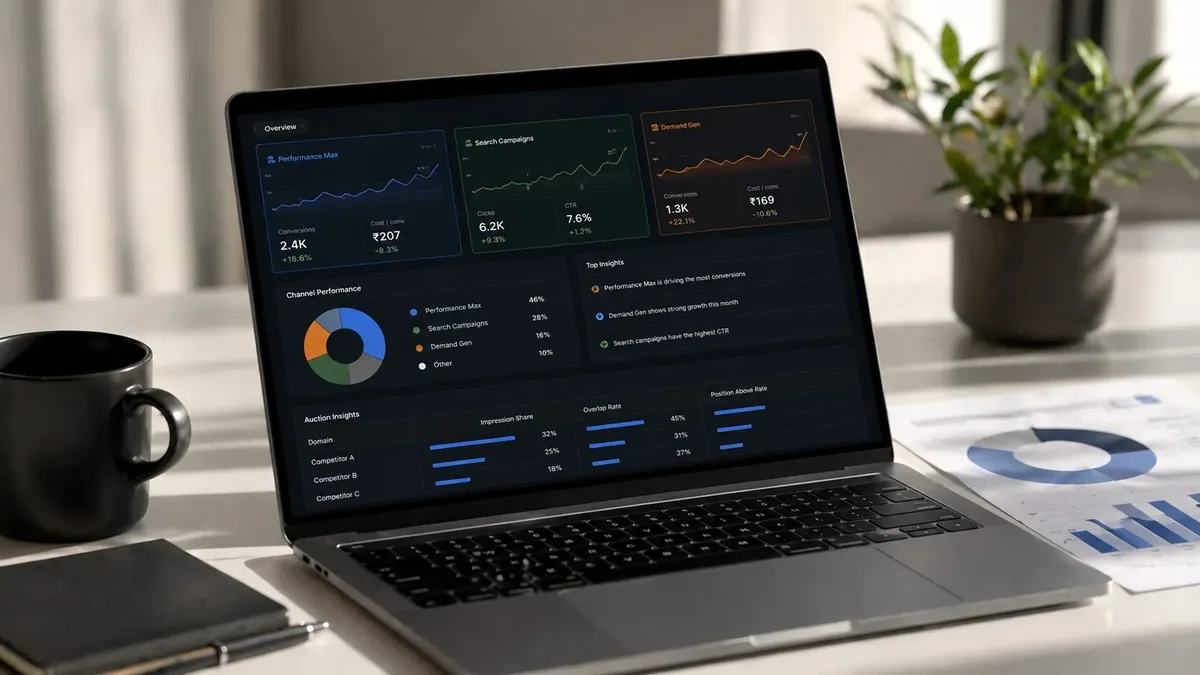
This approach combines three campaign types that work best when used together: Demand Gen, Performance Max, and AI-enhanced Search campaigns.
From our experience managing Google Ads accounts, understanding how these campaign types interact is no longer optional. It is essential for maintaining visibility, controlling acquisition costs, and generating consistent growth across multiple touchpoints.
In this guide, we break down how the Power Pack works, what each campaign contributes to performance, and how businesses can connect them into a single strategy that maximises return on investment.
The logic behind the Google Power Pack
Every customer journey typically moves through three stages:
Awareness
Consideration
Conversion
Each campaign type within the Power Pack supports one or more of these stages.
When structured correctly, they allow your brand to appear at the moments where potential customers:
- Discover your brand while browsing content
- Begin searching for solutions
- Decide to convert through targeted offers
Rather than operating as isolated campaigns, these systems allow Google's machine learning to connect awareness, intent, and action through shared data and automation.
From what we see across campaigns today, this integrated approach tends to outperform fragmented campaign strategies.
Component 1: Demand Gen campaigns
Demand Gen campaigns are Google's solution for upper-funnel awareness. They appear across high-engagement placements such as YouTube, Gmail, and Discover feeds.
These environments allow brands to reach users who have not yet searched for a product but are showing signals that suggest potential interest.
In our experience, Demand Gen works best when it introduces brands to new audiences in a way that feels relevant rather than intrusive.
Why Demand Gen matters
Many buying journeys begin long before someone types a search query. Video platforms and content feeds often shape early brand awareness.
Google reports that 91% of consumers take action after discovering new brands through platforms like YouTube or social feeds.
Demand Gen campaigns use audience signals from sources such as:
- Customer Match data
- GA4 audience segments
- Website engagement behaviour
These signals allow Google to expand reach beyond traditional manual targeting.
Key actions for success
From what we see in campaigns, Demand Gen performs best when businesses:
- Build visual creatives that mirror real customer situations
- Segment messaging by audience intent rather than using generic ads
- Test short-form video formats regularly
- Measure engagement metrics alongside conversion data
Demand Gen should not be judged purely on direct sales. Instead, it seeds awareness and builds audience signals that lower-funnel campaigns can use later.
Component 2: AI-enhanced Search campaigns
Search remains the strongest signal of user intent within the Google ecosystem. However, traditional keyword management is evolving as AI systems interpret search behaviour more dynamically.
Today, AI-enhanced Search campaigns combine traditional search structures with automated optimisation through tools such as:
- Broad match targeting paired with Smart Bidding
- Dynamic search ad generation
- Landing page expansion
- Audience signal integration
Rather than relying entirely on fixed keyword lists, Google evaluates contextual signals including:
- Device and location
- Query variations
- User behaviour patterns
- Historical conversion data
In practice, this allows campaigns to identify opportunities that manual targeting might miss.
Finding the balance between control and automation
Automation can expand reach and improve efficiency, but structure still matters.
From our experience managing search campaigns, the most successful setups still include:
- Clear negative keyword management
- Structured ad group themes
- Relevant landing page mapping
- Regular search term monitoring
AI works best when advertisers provide clear signals and structured data.
Example in practice
For example, a premium outdoor clothing retailer moved from phrase match keywords to a broad match strategy supported by Smart Bidding.
Within eight weeks:
- Conversions increased by 27%
- CPC reduced by 14%
- Manual bid adjustments became unnecessary
The key factor was strong conversion tracking, which allowed Google's system to learn quickly.
Without reliable conversion data, automation cannot optimise effectively.
Component 3: Performance Max campaigns
Performance Max campaigns allow advertisers to access all of Google's advertising inventory through a single campaign structure.
This includes placements across:
- Search
- Display
- YouTube
- Discover
- Gmail
- Google Maps
Rather than manually selecting placements, advertisers provide creative assets, audience signals, and conversion goals. Google's AI then determines where and when ads appear.
The primary goal of Performance Max
Performance Max campaigns are designed to drive sales or leads across multiple channels simultaneously.
When configured correctly, they allow Google's system to prioritise placements with the highest predicted conversion probability.
How we typically structure P-Max campaigns
In our experience, Performance Max campaigns work best when advertisers:
- Upload a variety of creative assets including images and videos
- Group assets around product categories or audience themes
- Use first-party audience data rather than broad interests
- Focus optimisation on conversion value or return on ad spend
One common mistake is running P-Max alongside traditional Search campaigns without coordinating signals. This can lead to overlap and inflated CPCs.
Using campaign exclusions and clear audience structures helps prevent this.
Building the synergy
The strength of the Google Power Pack comes from how these campaign types work together.
A practical framework looks like this:
Start with Demand Gen
Demand Gen campaigns introduce your brand to new audiences through visually engaging placements such as YouTube and Discover.
Users who engage with these campaigns can then be added to remarketing lists.
Capture intent with AI Search
As awareness builds, some users will begin searching for related solutions.
AI-enhanced Search campaigns allow Google to capture this intent while adapting messaging and targeting based on previous engagement signals.
Scale with Performance Max
Performance Max campaigns then expand reach by identifying users with similar behaviours and conversion potential.
Over time, this creates a continuous learning loop:
Awareness → Intent → Conversion → Data feedback → Expanded awareness
The more data flows between campaigns, the more effectively Google's systems can optimise performance.
Essential conditions before launching
Before implementing this approach, several foundational elements need to be in place.
Accurate conversion tracking
Automation depends on reliable signals.
Enhanced conversions, GA4 integration, and server-side tracking help maintain data accuracy even as privacy restrictions evolve.
Strong creative assets
AI can amplify effective messaging but cannot compensate for weak creatives.
We typically recommend planning regular creative refresh cycles and testing multiple variations early.
First-party data
Customer lists, email subscribers, and CRM audiences provide valuable signals that improve targeting accuracy.
These audiences often outperform generic platform-generated segments.
Clear KPI framework
Different stages of the funnel require different success metrics.
For example:
Awareness: impressions, engagement rate, view rate
Consideration: clicks, CTR, assisted conversions
Conversion: CPA, ROAS
Separating these goals improves optimisation accuracy.
Ongoing optimisation
Automation should never mean "set and forget".
Regular performance reviews should focus on:
- audience signals
- creative fatigue
- conversion paths
- network-level performance trends
Common pitfalls to avoid
- Launching all campaigns simultaneously without data: Phase campaign activation. Allow one campaign to generate learning signals before introducing additional automation layers.
- Ignoring YouTube data in P-Max: Video placements often influence early awareness and consideration. Reviewing assisted conversion reports helps reveal their contribution.
- Weak or limited creative assets: Automation requires multiple asset variations to test effectively. Campaigns with limited creative options often struggle to optimise.
- Poor landing page alignment: Ads must match the user's intent. If landing pages do not clearly answer the query or guide users toward conversion, performance suffers.
- Insufficient first-party data signals: Customer lists and CRM audiences provide stronger targeting signals than generic interest segments.
- Treating automation as fully hands-off: AI still requires strategic oversight. Monitoring audience signals, creative performance, and budget distribution ensures continued optimisation.
Final thoughts
The Google Power Pack reflects a broader shift in digital advertising.
Rather than managing isolated campaigns, advertisers are now building connected systems where awareness, intent, and conversion signals feed into one another.
Demand Gen introduces brands to new audiences. AI-enhanced Search captures intent when users actively begin researching solutions. Performance Max scales the strongest signals across Google's entire advertising ecosystem.
When these campaigns operate together, they create a learning loop where data continuously improves targeting and performance.
From what we see across campaigns today, businesses that combine strong creative assets, reliable data, and structured strategy are the ones seeing the most sustainable results.
Automation can accelerate growth, but it works best when guided by clear strategy and meaningful signals. When used correctly, the Power Pack approach allows advertisers to turn Google's AI systems into a genuine long-term growth engine.